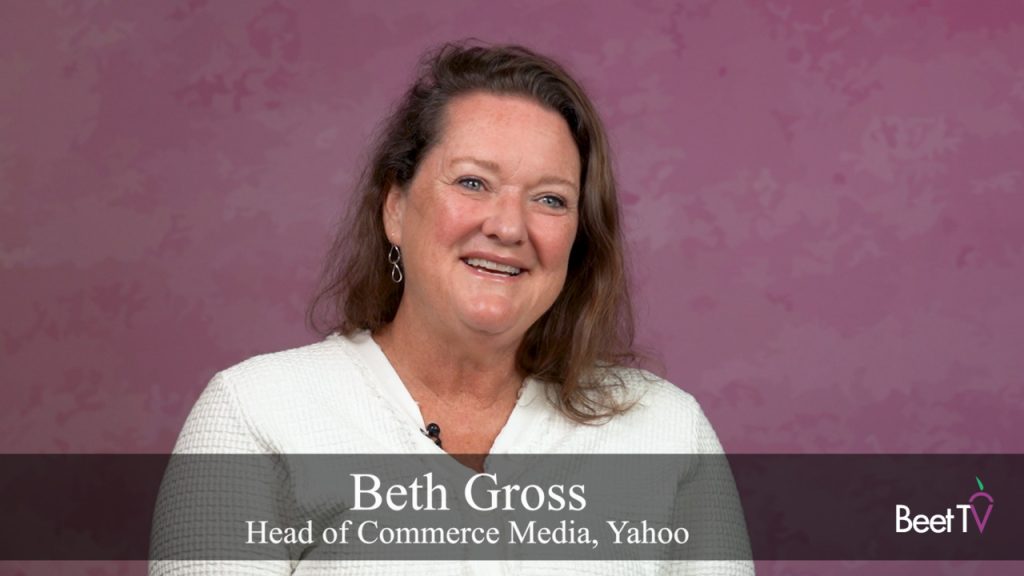
Beth Gross drops the mic on hidden fees right there in San Juan. No bid shading. No nickel-and-diming. Just straight-up transparency in a commerce media world that’s drowning in fine print.
Zoom out: Yahoo DSP’s head of commerce media is threading a needle between brands chasing shopper data and retailers building their own ad empires. It’s a $100 billion market by some estimates — growing 20% yearly, per eMarketer — and everyone’s scrambling for a slice. But Gross? She’s pitching Yahoo as the honest broker, serving two masters without selling out either.
Why Commerce Media Craves ‘Choice and Control’
“We call it choice and control. So we are all about transparency,” Gross told Beet.TV at the Beet Retreat.
“There’s no hidden fees or bid shading or nickel-and-diming our partners,” she added.
That’s the hook. Ad tech’s notorious for opaque pricing — think 30% spreads vanishing into the ether. Yahoo’s integrations span clean rooms, cloud platforms, even that stubborn spreadsheet your CMO won’t ditch. It’s flexible, sure. But here’s my take: this isn’t altruism. With Criteo and CitrusAd nipping at heels, Yahoo needs differentiation. Remember 2012’s DSP wars? Opacity turned players into commodities. Yahoo’s transparency play echoes Google’s AdWords pivot — clear rules won loyalty. Bold prediction: by 2026, platforms without fee ledgers will bleed 15% market share to transparent upstarts.
And it’s working. Brands get audience activation from commerce signals. Retailers? Infrastructure for their media networks. Two sides of the coin, Gross says, but the house always wins if trust erodes.
Retail media networks — Amazon, Walmart, Target — they’re exploding, sucking up 15% of digital ad spend already. Yahoo doesn’t own shelves, so it plays connector. Smart. Skeptical eye, though: dual loyalties risk conflicts. Help a retailer today, poach their brand tomorrow?
Can AI Agents Fix Commerce Media Without Firing Everyone?
AI’s knocking. Gross doesn’t panic. She rolls out “Yours, Mine, and Ours” — bring your agent, use ours, or mash ‘em up.
“If a partner, agency or brand has their own agents, bring it to the party,” she says.
Yahoo’s bots crunch reporting, troubleshooting, audience builds. Humans? They dream up strategies in the “Ours” zone. It’s collaborative, not replacement. Routine tasks automated — who cries for those? But let’s be real: agencies bloated with juniors will trim. McKinsey pegs 30% of ad ops jobs at risk by 2027. Yahoo’s framing softens the blow, positions them as team players.
Picture it: brand’s GPT-4o agent pings Yahoo’s for real-time signals. smoothly? Maybe. Yahoo’s scale — billions in impressions — gives it edge over solo AI tinkerers.
Yet, humans hold keys. Good. AI hallucinations in bidding? Disaster waiting. Gross’s model hedges that.
The Real Winner: One-to-One Purchase Signals
Flashy dashboards? Meh. Gross bets on data that bites — actual buys.
“The partners that are really gonna win are gonna have that one-to-one purchase signal,” she warns.
“While modeling and predictive tools still matter, she warned that targeting people who have already converted is not a growth strategy. Instead, she urged brands to lean into first-party data and use it to find new customers, not just congratulate existing ones.”
Nailed it. Look at numbers: Retail media ROI crushes display at 2.5x, per IAB. Why? Closed-loop attribution. Modeling’s fine for prospecting, but nothing beats “they bought it.” Yahoo’s pushing first-party firehoses from partners. Winners: platforms linking signals to carts, not cookies.
Critique time. Industry spin calls this “incrementality.” Please. It’s table stakes. Yahoo’s PR polishes it shiny, but execution’s key. Integrations galore sound great — until APIs clash. We’ve seen it: LiveRamp fumbles, data dries up.
Market dynamics shift fast. Commerce budgets hit $200B by 2028? Platforms with purchase truth serum dominate. Yahoo’s positioned, but Amazon’s walled garden laughs last.
Here’s the thing — Gross’s vision makes sense. Transparency cuts noise. AI teamwork scales humans. Purchase signals drive growth. But dual roles? Tread carefully. One whiff of favoritism, and it’s back to fee wars.
San Juan’s buzz fades, but commerce media’s grind doesn’t. Yahoo’s not revolutionizing — it’s refining. In a hype-filled ad world, that’s gold.
Does Yahoo’s Strategy Actually Scale for Small Brands?
Scale’s the rub. Big retailers thrive on Yahoo’s pipes. But indie brands? Spreadsheets rule there. Gross touts flexibility — plug in anywhere. Data partners: dozens. But cost? Transparency helps, yet Yahoo’s cut — even clean — adds up.
Parallel: Early programmatic scared SMBs with black boxes. Transparent DSPs like The Trade Desk won them over. Yahoo could too, if pricing stays true.
Prediction: If Yahoo open-sources some AI agents, adoption spikes 40% among mid-tier players. Game theory — share to conquer.
Humans wander, strategies evolve. Gross gets that.
🧬 Related Insights
- Read more: Horizon’s Campanelli Slams CTV’s ‘Extra Step’ to Real Performance
- Read more: AppLovin CEO Ditches Chair Role as Execs Exit Stage Left
Frequently Asked Questions
What is Yahoo DSP’s ‘Yours, Mine, and Ours’ AI model?
It’s a collaborative framework where partners use their AI agents, Yahoo’s, or combine them for tasks like reporting and audience building — keeping humans in creative control.
How does commerce media transparency impact ad spend?
By ditching hidden fees and bid shading, platforms like Yahoo build trust, potentially shifting 10-20% of budgets from opaque networks to clear ones, boosting efficiency.
Why do purchase signals matter more than predictive modeling?
One-to-one buy data proves ROI directly, fueling growth via first-party signals to find new customers, not just retarget loyal ones.