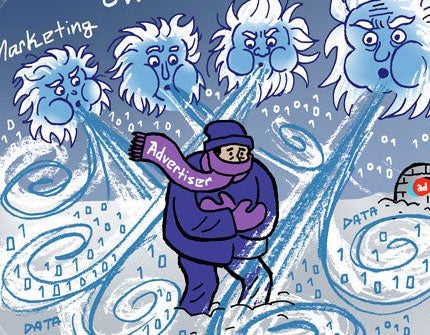
Everyone was expecting the AI revolution in advertising to be a smooth, effortless takeover. Imagine agents, sleek and efficient, zipping through the digital ad landscape, optimizing every dollar, every impression, every conversion. It was pitched as the ultimate efficiency engine, a turbo-boost for marketers. But here’s the thing – the reality, as it often does, decided to throw a wrench in the works.
And that wrench? Complexity. Emily Lai from WPP Media dropped a rather blunt truth bomb at AdExchanger’s Programmatic AI event: 80% to 90% of campaigns are just too darn complex for AI to handle solo. Simple, straightforward programmatic guaranteed or deal-based buys with minimal targeting? Sure, AI can probably wrangle those. But expecting it to orchestrate today’s average media plan, with all its nuanced layers and strategic imperatives? Unrealistic, she says.
This isn’t even touching the minefield of highly regulated sectors like healthcare. Oleg Korenfeld, CTO of WPP-owned CMI Media Group, highlighted this, noting that having AI agents “talking to each other at scale across all campaigns? It’s just not realistic.” He even jokingly, or perhaps not so jokingly, threw out a challenge to hear what Tony Katsur from the IAB Tech Lab would say.
The Pragmatic Prophet: Tony Katsur’s Take
So, what does Tony Katsur, CEO of the IAB Tech Lab, have to say about AI’s ad-buying prowess? The Tech Lab has been a cheerleader for AI, diligently developing frameworks and “agentifying” its standards. You’d expect them to be all-in, right? Well, Katsur, despite his organization’s efforts, offered a refreshingly grounded perspective. He agreed: “I’d agree that we’re not there yet. For simple things, yes, but there’s still a lot of work to do.” It’s a clear signal that the path to full autonomy is longer and more winding than some might have hoped.
It’s like expecting a self-driving car to navigate a brand new, unmapped, and constantly shifting city grid with a thousand unexpected detours. The foundational tech might be there, but the real-world complexity — the pedestrian suddenly darting out, the road closure, the spontaneous parade — that’s what humans are still better equipped to handle.
The CMO’s Ever-Expanding Domain
But the conversation doesn’t stop at ad tech’s operational challenges. We’re also seeing a fascinating shift in organizational structures, particularly around the Chief Marketing Officer role. Expedia, for instance, has brought its retail media business under the CMO’s purview. This isn’t just a title shuffle; it positions the CMO directly in a revenue-generating seat, blurring the lines between marketing, sales, and operational units like customer service and supply chain.
Jochen Koedijk, Expedia’s CMO, frames this as a strategic growth play. He sees advertising as having significantly more growth potential than traditional marketing going forward, particularly as Expedia leans into data and tech solutions for partners. This is a seismic shift – the marketer not just spending money to acquire customers, but directly earning revenue by enabling others to advertise on their platform. It’s a move that elevates the CMO from a strategic planner to a Chief Make-Money Officer.
The Airbnb Enigma: A Holdout in the Retail Media Frenzy
Amidst this surge in retail media, Airbnb stands out as a notable holdout. They possess a treasure trove of data, unique physical and digital spaces for advertising, and rich audience segmentation capabilities. Yet, they’ve largely sidestepped the ad revenue gold rush. While they have a ‘services’ revenue line that could encompass advertising, they’re expanding it with tangential offerings like car rentals and airport pickups, akin to building out an app store.
CEO Brian Chesky has even pointed to Amazon as an inspiration. This, coupled with the app-store analogy and the expanding services layer, certainly sounds like they’re laying the groundwork for a strong advertising business. However, for now, they’re content with organically recommending services within their app, eschewing the direct capture of ad revenue. It’s a curious strategy, a deliberate pause in a race where others are sprinting.
Could this be a strategic play to build out their ecosystem first, making their platform even more valuable before they introduce advertising? Or are they simply content with their current revenue streams, wary of complicating their user experience? It’s a question that hangs in the air for a company with such immense latent advertising potential.
A Glimpse into the Wider AI/AdTech Universe
Beyond the core ad-buying discussion, a flurry of other developments paints a broader picture of the current state of play. James Murdoch’s acquisition of half of Vox Media, Omnicom’s shift away from LiveRamp following the Publicis deal, and Google’s inevitable integration of more ads into its new Search AI pivot all underscore the dynamic, and sometimes turbulent, nature of the industry. Meta’s significant layoffs, ostensibly to fund AI investments, serve as a stark reminder of the costly pivot underway. And the concerning observation that the web is increasingly being optimized for AI rather than humans highlights a critical ethical crossroads.
**
🧬 Related Insights
- Read more: IAB Tech Lab: Bidstream Signals Get Real-Time Boost [AI Platform Shift]
- Read more: AI Content Gets Real: Video Fueling RAG Libraries
Frequently Asked Questions**
What is the main limitation of AI in ad buying currently? AI struggles with the complexity of most modern media plans, with estimates suggesting 80-90% are too complex for full automation.
Will AI eventually be able to handle all ad buying? Industry experts believe significant work is still needed, and while AI will improve, full end-to-end autonomy for complex campaigns remains a distant prospect.
What is retail media? Retail media refers to advertising opportunities offered by retailers on their own platforms, leveraging their first-party data to target shoppers.