Are you spending more time wrangling spreadsheets than strategizing campaigns?
It’s a question few performance marketers dare to whisper, but it hangs heavy in the air on any given Monday morning. The ritual is depressingly familiar: log into Google, then Meta, then LinkedIn, then TikTok, then Reddit. Pull numbers. Force them into a story. Pray your boss/client buys it by 10 a.m. Somewhere in the chaos, you’re supposed to figure out what actually worked. Utterly charming.
Remember when ‘multi-channel’ meant Google and maybe a side hustle on Facebook? That was a Tuesday. Now you’re juggling ten, eleven networks. Each with its own bizarre attribution logic. Its own campaign structure. Its own warped definition of what a ‘conversion’ even is. The data doesn’t just live in different zip codes; it speaks entirely different dialects.
And yet, we soldier on. Most teams still manage this digital circus like it’s 2019: too many browser tabs, endless spreadsheets, and those soul-crushing Monday mornings.
The Monday Morning Black Hole
Here’s the dirty little secret: most of the time paid media teams spend on “campaign management” isn’t management at all. It’s digital drudgery.
Data entry. Reformatting. Logging in and out of platforms until your eyes blur. Rebuilding the same damn campaign brief five times because Google’s structure won’t map to Meta’s, and neither maps to LinkedIn’s.
Industry whispers suggest paid media managers spend 5 to 9 hours a week on pure administrative pain. My gut, and years of doing this job myself, say that’s a ridiculously optimistic number for anyone touching more than a handful of networks. Agencies wrangling multiple clients across a dozen platforms? Easily double that. Think about it: 10 hours a week. That’s 40 hours a month. Five full workdays. Five days you’re not actually optimizing. If you bill that time, clients are paying for busywork. If you eat it internally, it’s a hidden cost eating your margins. Every. Single. Week.
And the errors? Oh, the glorious errors. Manual data transfer is just manual error introduction. Budget caps mistyped. Negative keyword lists that mysteriously vanish between platforms. A campaign mysteriously paused on Google while it’s still burning cash on Meta because nobody noticed. Small stuff, maybe. But small stuff compounds.
What’s Really Getting Lost?
Look, the time suck is real. But it’s almost secondary. The real killer is the lag. When your performance data is scattered across a dozen silos and only gets pieced together once a week, you miss the crucial optimization window. That insight—LinkedIn is hemorrhaging money while Google is starving—is obsolete by the time you see it. The creative that died a quiet death on Wednesday? You won’t know until Monday. Another week of wasted ad spend. Poof.
There’s also a consistency plague. Building campaigns natively in each platform means the strategy inevitably drifts. Audience definitions diverge. Budget logic becomes a patchwork quilt. Creative changes happen not because of a strategic decision, but because you were just too damn tired by Thursday afternoon to do it right on LinkedIn.
For agencies, it’s a compounding nightmare. Thirty native dashboards. Thirty sets of credentials. Thirty manual data pulls to cobble together into some semblance of a report. It’s exhausting. And frankly, most teams have just thrown up their hands and accepted it.
Why the Native Dashboards Won’t Save You
Let’s be brutally honest: Google, Meta, LinkedIn—none of them are going to fix this cross-network management problem. They can, but they won’t. Their incentive is to keep you glued to their interface. Time in Google Ads is time you’re not questioning whether Google deserves that budget. It’s a feature, not a bug.
Sure, APIs exist. Integration ecosystems sprout like weeds. But try managing a multi-network buy through them. It still feels like wrestling an octopus in a phone booth. The gap hasn’t closed; it’s just been plastered over with more software. And people. So many people.
What if you never had to log into 12 different platforms again? What if campaign management wasn’t about data entry and reformatting, but about actual strategy? This isn’t a pipe dream. It’s the next logical step.
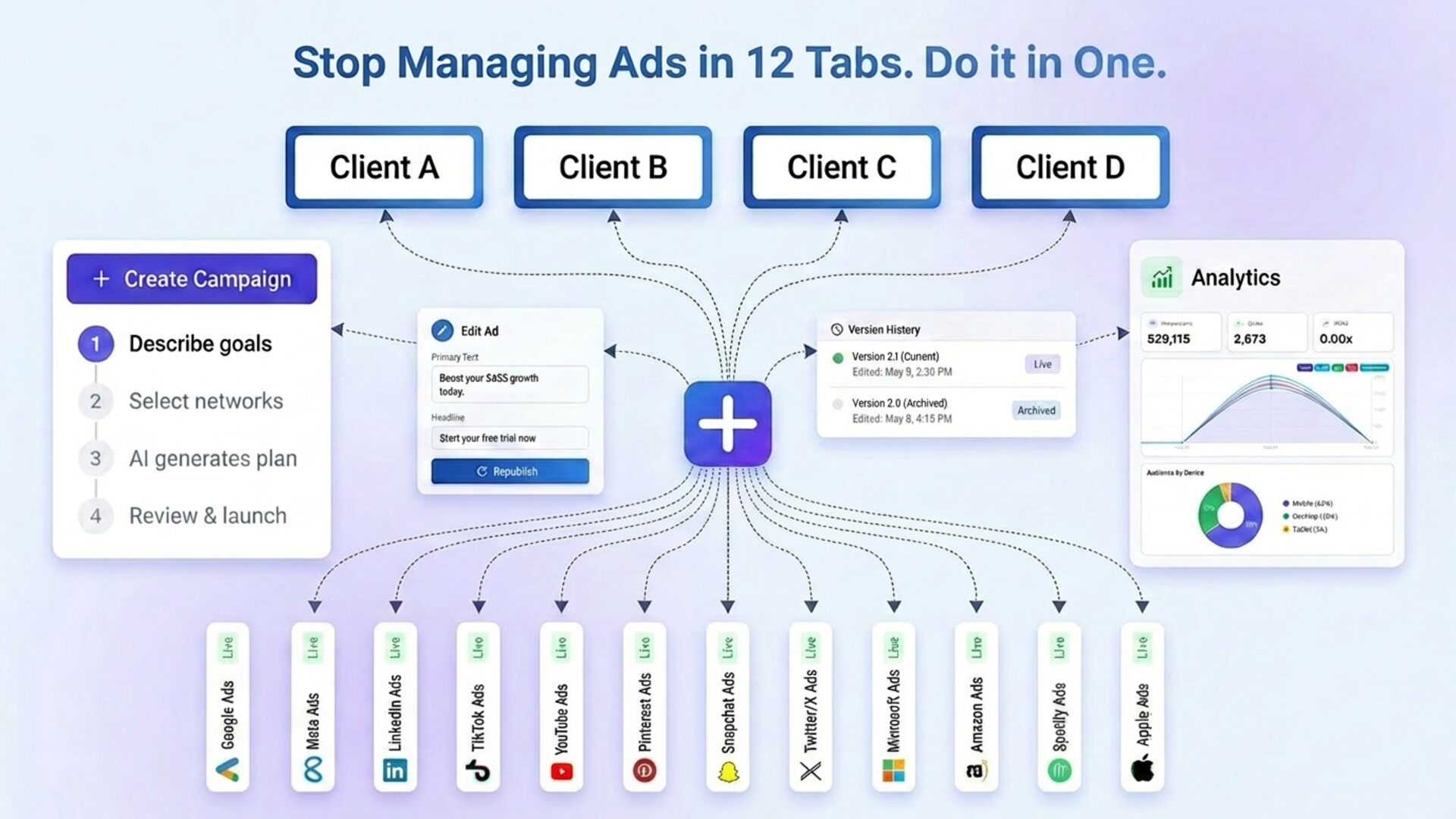
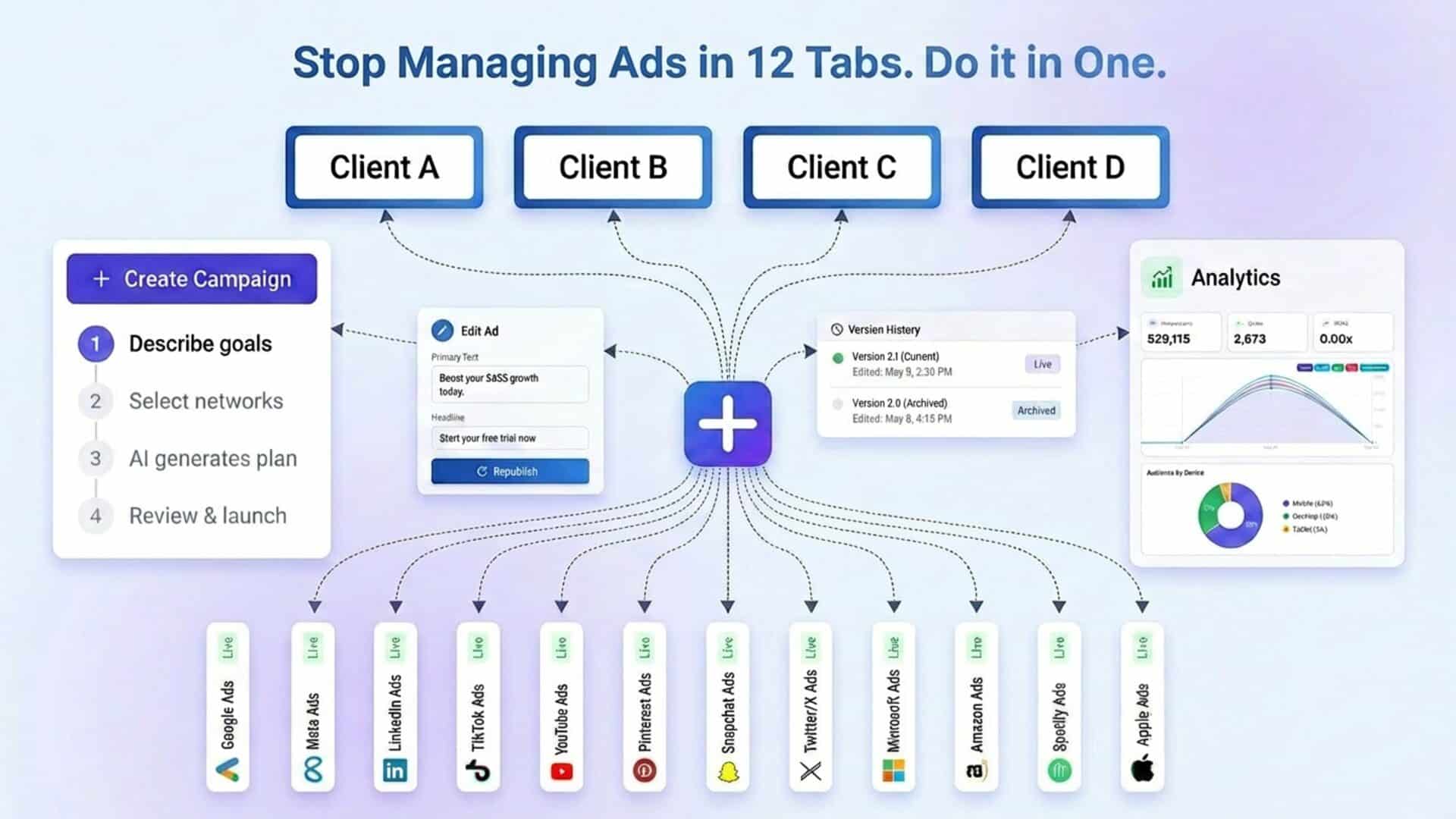
AdPlus claims to offer a solution. They’re touting a unified platform designed to tackle this very cross-channel chaos. The promise: to liberate performance marketers from the daily grind of manual reporting and duplicated effort. Instead of stitching together disparate data, the idea is to build and manage campaigns from a single point of control.
The cross-channel ad ops problem is real and mostly ignored. Here’s what it’s costing performance marketers — and what’s actually changing.
This isn’t just about saving time, though that’s a massive benefit. It’s about regaining agility. Imagine spotting a performance dip on Wednesday and adjusting budgets by Thursday. Imagine consistent strategy applied across all channels, not diluted by platform-specific quirks. Imagine less wasted spend and, dare I say it, better results. The AdPlus pitch suggests this is achievable by abstracting away the individual platform complexities, allowing for a more holistic view and control.
Is this the silver bullet? History is littered with platforms promising to unify the ad tech landscape, only to become another layer of complexity. But the pain point AdPlus is addressing is so visceral, so universally felt by anyone in performance marketing, that a genuine solution would be nothing short of a miracle. A miracle that could reclaim entire days of marketer time and significantly improve campaign effectiveness.
We’ve seen this play out before. Early days of programmatic advertising were a fragmented mess, requiring deep expertise in specific platforms. Over time, unified platforms emerged, offering a more streamlined approach. The current state of cross-channel management feels like we’re back in that pre-unified era. The key question isn’t whether AdPlus can technically connect to these platforms, but whether they can truly simplify the workflow and deliver on the promise of reclaiming strategic thinking time.
The AdOps Agony
The core issue is that each ad network is designed to be a walled garden. They want you spending time and money within their ecosystem. This fragmentation isn’t accidental; it’s the business model. For AdPlus, or any similar platform, to succeed, it has to offer a compelling reason to step outside those gardens and manage campaigns more broadly. That reason has to outweigh the perceived benefits of native platform tools.
If AdPlus can genuinely untangle this knot, freeing up marketers to focus on strategy rather than data wrangling, it won’t just be a new tool. It’ll be a revolution in how performance marketing is done. The question is whether their approach is strong enough to overcome the ingrained incentives of the ad networks themselves. It’s a tall order. But the alternative—more Monday mornings spent drowning in spreadsheets—is frankly unbearable.
Will this actually fix the problem?
Theoretically, yes. A truly unified platform could solve the cross-channel ad ops nightmare. It would reduce manual data entry, ensure campaign consistency, and speed up optimization cycles. The challenge lies in the execution. Can AdPlus smoothly integrate with all major platforms? Can it provide insights and control that are genuinely superior to the native dashboards, even when used in conjunction with other tools? The proof will be in the performance metrics and the saved hours.
What does unified campaign management mean?
Unified campaign management refers to using a single platform or interface to plan, execute, monitor, and optimize advertising campaigns across multiple channels (like Google Ads, Meta, LinkedIn, etc.) simultaneously. Instead of logging into each network’s dashboard separately, all activities are consolidated, streamlining workflows and providing a holistic view of campaign performance.
🧬 Related Insights
- Read more: Alibaba’s AI Chatbot Reshapes E-commerce
- Read more: Google’s Gemini: Is This the End of Creative Bottlenecks?
Frequently Asked Questions
What is the main problem with managing campaigns across 12 channels?
The primary problem is the immense administrative overhead. Marketers spend excessive time on data entry, reformatting, logging into multiple platforms, and rebuilding campaigns for each network. This leads to errors, missed optimization opportunities due to reporting delays, and strategic drift.
Will a unified platform like AdPlus eliminate the need for platform-specific knowledge?
Unlikely. While a unified platform aims to simplify the management of campaigns, a solid understanding of how each individual platform operates and its unique strengths and weaknesses will likely remain beneficial for advanced optimization and strategy. The platform aims to abstract complexity, not eliminate expertise.
How much time can marketers realistically save with unified campaign management?
Practitioners report spending 5-9 hours per week on administrative tasks alone. A unified platform could potentially reclaim a significant portion of this time, freeing up marketers to focus on strategic initiatives and deeper analysis.