The hum of a server room is replaced by the frantic click-clack of a keyboard, another Monday morning ritual.
Ask any paid media manager how their week begins, and you’ll get a symphony of sighs and stories about Google Ads, Meta, LinkedIn, TikTok, Reddit. Pulling data. Sticking it in a spreadsheet. Trying to make it tell a story by 10 a.m. Somewhere in that chaos, they’re supposed to figure out what worked last week. And why.
What a way to start a Monday.
I’ve been in this game long enough to recall when “multi-channel” meant Google and maybe a side hustle on Facebook. That was a handful. Now? You’re juggling 10, 11, maybe more networks. Each with its own idea of what a conversion is. Its own attribution. Its own inscrutable campaign structure.
The data doesn’t just reside in different zip codes; it speaks entirely different dialects. And despite this linguistic Babel, most teams are still trying to manage it all like it’s 2019: too many browser tabs, endless spreadsheets, and those soul-crushing Monday mornings.
The Unspoken Monday Morning Tax
Here’s the thing nobody wants to talk about: most of the time paid media folks spend on “campaign management” isn’t actually managing campaigns. It’s busywork.
Data entry. Reformatting nightmares. The endless dance of logging in and out of platforms. Rebuilding the same campaign brief five times because Google’s structure is a stranger to Meta’s, and both are utterly alien to LinkedIn’s.
Industry numbers claim paid media managers spend 5-9 hours weekly on sheer admin. My gut, from doing the job and hearing from others, says that’s downright optimistic if you’re touching more than three or four networks. Agencies wrangling multiple clients across a dozen platforms? Easily double that.
Think about what 10 hours a week translates to. That’s 40 hours a month. A full work week. Gone.
If you’re billing that time, a hefty chunk of your client’s retainer isn’t going to the actual strategy. If you’re eating it internally, it’s a hidden cost that never shows up on your ROAS report but absolutely decimates your margins. Every. Single. Week.
And the errors? Oh, the errors. Manual data transfer is just a fancy way of saying manual error introduction. There’s no escaping it.
- Budget caps mistyped.
- Negative keyword lists that stay put in one platform but vanish in another.
- A campaign killed in Google, but chugging along in Meta because nobody noticed.
Small things, yes. But small things have a nasty habit of piling up.
More Than Just Time: What’s Actually Leaking Away
The time cost is a real pain. But it’s not the main event.
The bigger culprit is the lag. When your performance data is scattered across 12 different silos, only to be pieced together once a week, you’re missing your optimization window. Poof. Gone.
That insight screaming that LinkedIn is bleeding cash while Google is starving? It surfaces just as the budget’s already evaporated. The creative that died a quiet death on Wednesday? It waits until Monday for its autopsy.
Another week, more wasted spend.
Then there’s the consistency problem. It’s subtler, but just as costly. When campaigns are built natively, one brief warped into five different interfaces, the strategy starts to fray.
- Audience definitions stop aligning precisely.
- Budget allocation becomes haphazard.
- Creative pivots happen not from strategic intent, but because you were just too darn tired by Thursday afternoon when you finally got to the LinkedIn build.
For agencies, it’s even worse. You’re not just managing strategic drift across networks, but across clients. Thirty native dashboards. Thirty sets of login credentials. Thirty separate reports to manually fuse every week.
I’ve been there. It doesn’t get easier. It’s a lot. And let’s be honest, most teams have just shrugged and accepted it as the price of doing business.
Native Dashboards Are Not Your Friend
Let me be blunt: Google, Meta, LinkedIn, and all the other ad goliaths aren’t going to fix the cross-network management headache. Not because they lack the capability, but because they lack the incentive.
Every platform is wired to keep you hooked inside its own walled garden. Time spent in Google Ads is time you’re not questioning whether that budget belongs there. Same for Meta. Same for LinkedIn.
This fragmentation isn’t an oversight. It’s the product. They want you in their sandbox.
Sure, they offer APIs. They tout integration ecosystems. But try using them and tell me the problem feels solved. Managing a multi-network campaign in 2026 still means logging into a dozen different tools. The gap hasn’t shrunk; it’s just been papered over with more software.
Anyway.
The real solution has to come from the other end of the telescope: not ‘how do we patch together the outputs of 10 disparate platforms,’ but ‘what if you never had to begin there?’
The Hidden Drain: Why Aggregation Isn’t Enough
Most solutions today are just fancy stitching. They pull data out of each platform and dump it into a central dashboard. A prettier spreadsheet, basically.
This is like trying to fix a leaky roof by putting a bucket underneath. It catches the drips, sure, but it doesn’t stop the rain. The problem – the fundamental inefficiency of building and managing campaigns natively in 12 different UIs – remains.
Think about the historical parallel here. In the early days of computing, we had bespoke hardware for every task. Then came operating systems that standardized things. We don’t build a separate computer for word processing and another for spreadsheets. We have a unified interface.
AdTech is stuck in the pre-OS era for campaign management. The current approach treats each ad platform as a separate island, requiring its own unique infrastructure for communication and management. It’s archaic.
Is There a Better Way Than Manual Hell?
Yes. But it requires a paradigm shift.
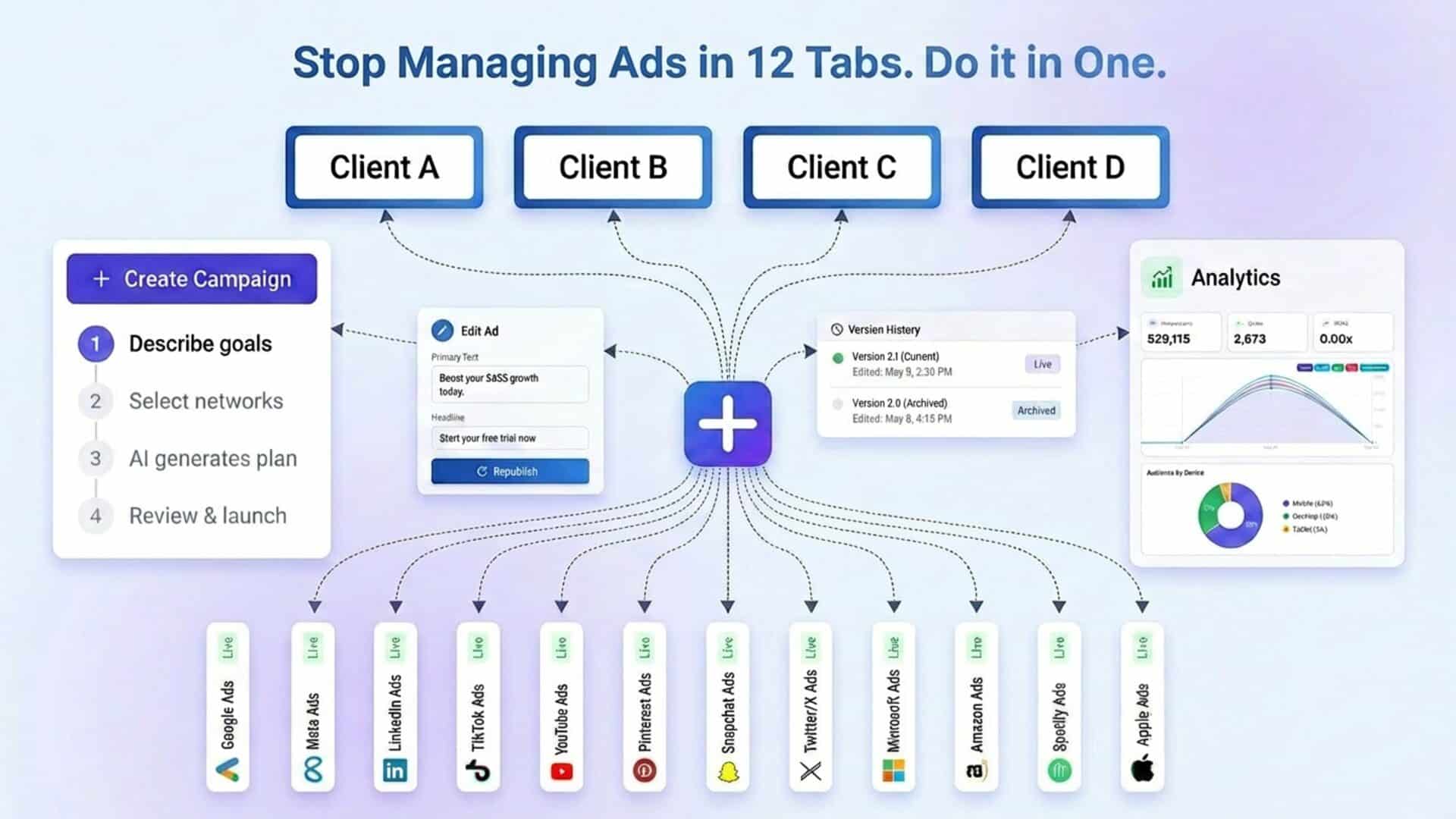
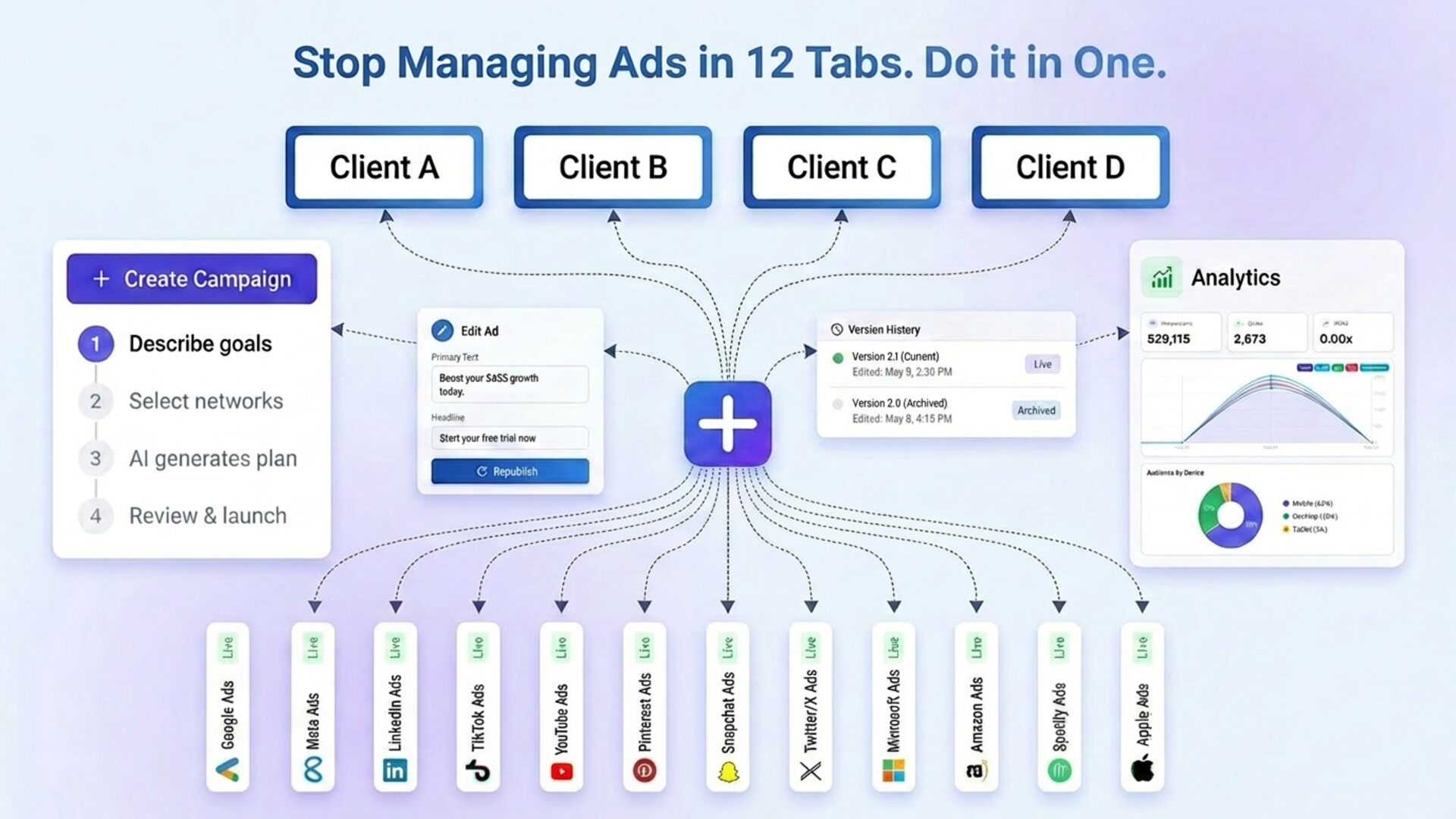
Instead of trying to aggregate the outputs of siloed systems, the focus needs to be on a unified system that generates campaigns and assets across channels from a single source of truth. Imagine defining your audience, your creative, your budget, and your core strategy once, and then having that information intelligently deployed and adapted across all your target networks.
This isn’t about a reporting tool. It’s about an execution and management platform. A platform that abstracts away the native UIs and their inherent inconsistencies. It’s about a system that understands that the goal is not to master 12 dashboards, but to achieve a singular marketing objective. The tech exists. The industry just seems remarkably resistant to adopting it, preferring the comfort of familiar, albeit broken, workflows.
What’s the Real Cost of This Multi-Channel Mess?
The time spent on manual tasks is a direct hit to productivity and profitability. But the indirect costs are often more significant. The missed optimization windows mean wasted ad spend – money that could have been reinvested or simply saved.
The drift in strategy due to inconsistent implementation across platforms leads to fragmented brand messaging and diluted campaign effectiveness. You’re not running one cohesive strategy; you’re running 12 slightly different, less effective ones.
For agencies, this translates to reduced profitability per client and increased operational risk. For in-house teams, it means an inability to scale effectively and a constant struggle to demonstrate value beyond the most basic metrics. It’s a bottleneck that stifles growth.
It’s a problem that’s been simmering for years, accepted as an unfortunate reality of modern digital advertising. But as the number of channels proliferates, the problem only intensifies. It’s an arms race against inefficiency, and most marketers are losing.
🧬 Related Insights
- Read more: AI Citations: AEO Dominates 2026 Search [Webinar]
- Read more: NAB 2026: AI Isn’t Just Talking, It’s Doing.
Frequently Asked Questions
What does AdPlus actually do differently? AdPlus aims to provide a unified platform for campaign execution and management, reducing the need to interact with individual native ad network dashboards and their disparate campaign structures.
Will this replace my job as a paid media manager? If your job primarily consists of manual data entry, platform logging, and rebuilding campaign briefs across different interfaces, then yes, a system like AdPlus could automate those tasks, freeing you up for more strategic work.
Is this just another reporting tool? No, the focus is on execution and management from a single source of truth, rather than solely on aggregating data from disparate systems.